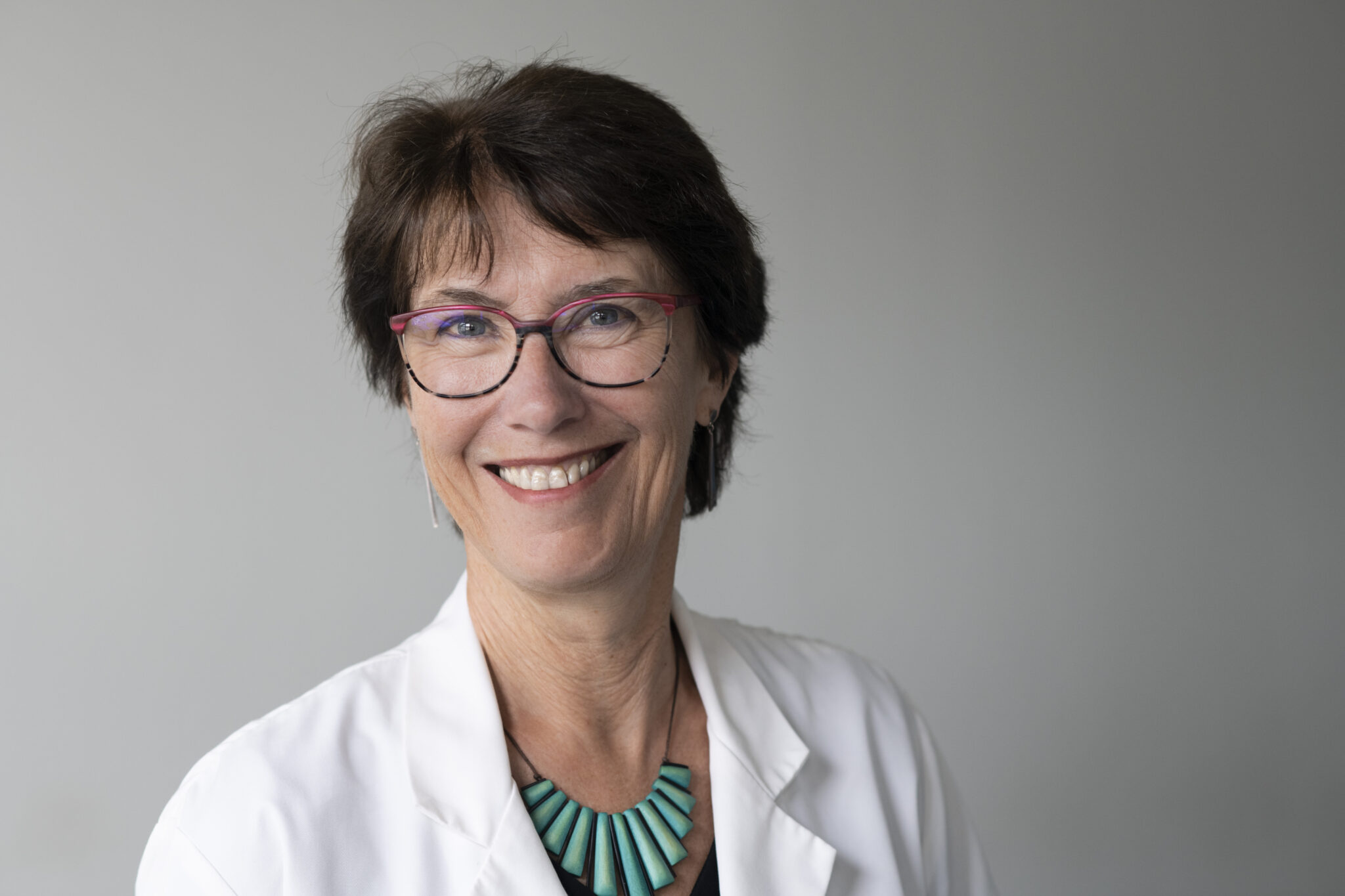
Interview with EHA’s European Affairs Committee Chair, Elizabeth Macintyre
Hematology diagnostics expert and former EHA President, Elizabeth Macintyre found her place in European advocacy. In an interview with EHA, Elizabeth opens up about her time on the European Affairs Committee and explains the importance of bridging the gap between the academic and EU legislative bubbles.
European affairs represents hematologists at the EU level. What does this look like, and why is it so important?
It has never been more important for Europe to become an operational, competitive community which works for European citizens, both internally and on the world stage. As the European Union increases its legislative work in the health domain (pharmaceuticals, biotech, health data, in-vitro diagnostics), hematologists need a seat at the table – or decisions will be made without us.
This requires “unity in diversity”, which starts with communication – a prerequisite for confidence. EHA has contributed to this within the hematology community, first via its congress and support for research and education, but increasingly through policy and advocacy to the many stakeholders in the EU landscape, via the European Affairs committee and its indispensable policy officers.
EHA advocates independently on (the many) hematology-specific issues, and collectively with other medical societies on transversal issues, such as cancer, health data, and more!
Our future as hematology practitioners and/or researchers depends on ensuring that the laws that govern us are fit-for-purpose. This requires anticipative advocacy, since constructive development is easier and less painful than dissatisfied criticism.
EHA’s policy and regulatory work is steered and overseen by the European Affairs Committee (EAC). As this Committee’s Chair, what have you found particularly rewarding and challenging?
I joined the EAC in 2016, as we were building links with patient representatives prior to creation of the patient advisory committee (PAC). It was both challenging and rewarding to see the (now 15) patient representatives assume their – now indispensable – role within and beyond the PAC and EAC, in congress planning and board representation, and more!
Multistakeholder representation in health is indispensable, particularly when prioritizing access and resources, so medical societies such as EHA must learn to live outside our “academic bubble”– as I have learnt on the EAC.
No one, least of all me, thought I could get excited about regulatory and innovation science, but durable wide-reaching change is more likely to come from legislative optimization than from niche innovation, however important the latter may be.
Legislative optimization also means reducing bureaucracy and seeking the best compromise between risk reduction, and intelligent use of resources and respect for (academic) innovation. The EHA-led Coalition for Reducing Bureaucracy is a great example of this.
Could you share a few highlights from your time on the European Affairs Committee?
Personal highlights include working with our wonderful policy officers and learning from our complementarity and interdependence – equivalent to the duo between a clinician and their nurses, or a “diagnostician” and their laboratory technicians.
The fact that I “graduated” from the EAC to the BioMedical Alliance in Europe (of which EHA is a member) has been a wonderful expansion of my range of medical policy vision and an enriching professional culmination, for someone who believes in Europe and its endless potential.
It is also a pleasure to see how many younger EAC members quickly grasp the relevance of policy and advocacy at European level.
As a hematologist, which EU opportunities and challenges do you see on the horizon?
All medical specialties, in all countries, will increasingly face the dilemma of ever more costly treatments, unequal access and increasing competition from other, pressing, priorities. We must be constructive contributors to making the difficult decisions on best use of resources, at both EU and member state level, in a configuration where the latter work together to optimize health and well-being for all.
Covid taught us that a “certain” European health space is desirable. Although health will remain – to a large extent – a member state competence, it is up to us to define “certain” and ensure that EU policies and legislation fit the reality and needs of clinicians and researchers, and the patients who depend on our care. At a more personal level, I hope to have put diagnostics on the map, as one of our main weapons for optimizing personalized medicine!
Why should someone join the European Affairs Committee?
The EAC is an enriching space that is likely to interest anyone who wants to look at their hematological practice from a novel angle and/or learn how to build a better future with existing means in Europe.
It is also an excellent opportunity to start to understand the European health space and how we at EHA can constructively contribute to making Europe the place-to-be in the future, now.