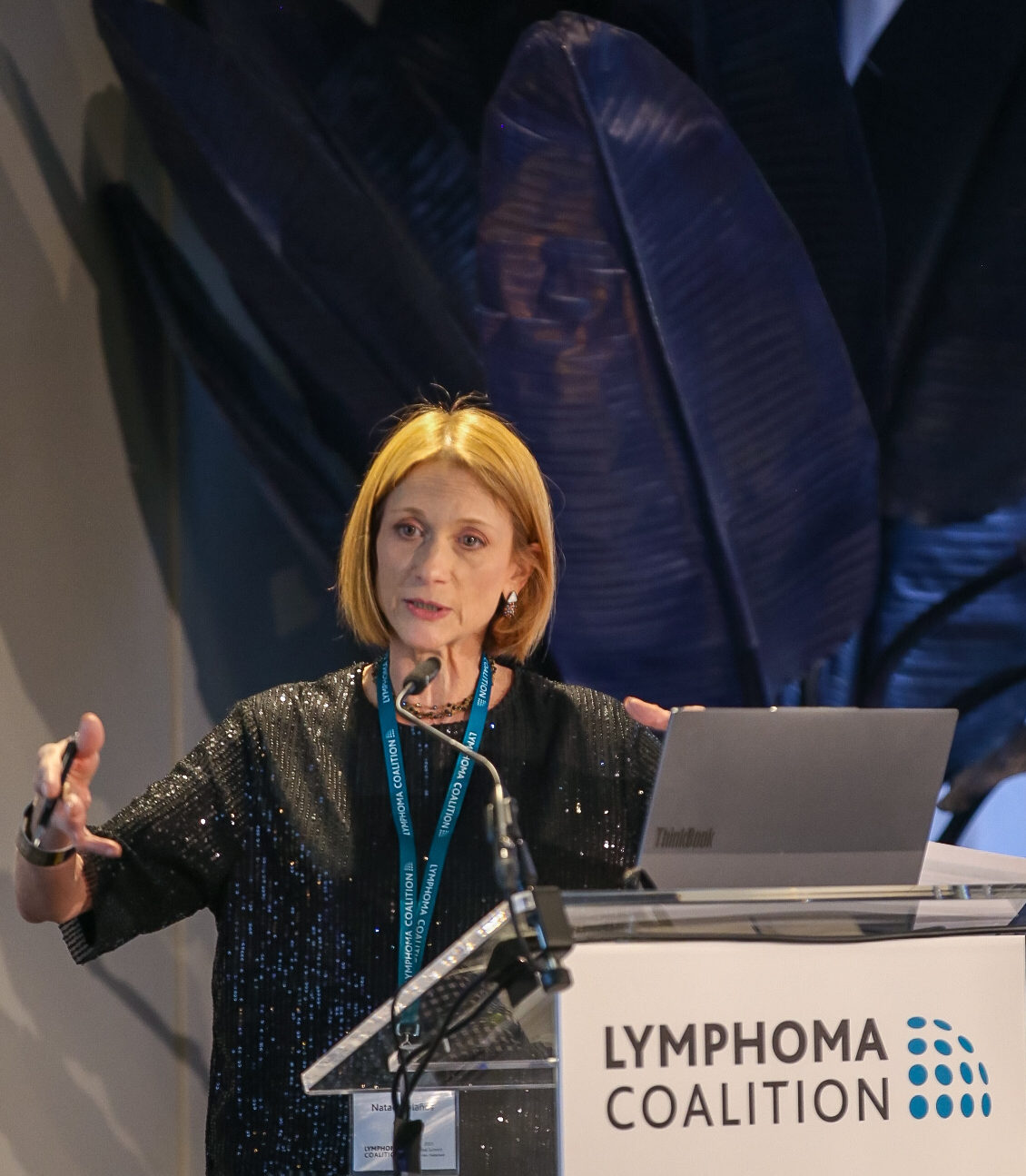
Interview with EHA’s European Affairs Committee Member, Natacha Bolaños
Natacha Bolaños is an experienced and passionate patient advocacy leader, currently serving as Head of Membership & Alliances at Lymphoma Coalition. She is deeply committed to building strong partnerships, and advancing collaborative approaches that amplify the patient voice across stakeholders. At EHA, Natacha contributes her valuable insights to the Patient Advocacy Committee and the European Affairs Committee.
Why is patient representation on the European Affairs Committee so important?
Being part of the European Affairs Committee (EAC) is not symbolic for me—it is deeply personal and a true responsibility. European policies shape realities that patients live every day: how research is funded, how evidence is evaluated, and how quickly innovative therapies reach the people who need them. Without the patient voice at the table, decisions are disconnected from the lived reality of those navigating illness, uncertainty, and complex care pathways.
Scientific progress in hematology is moving incredibly fast, but patient access is not. A delay of just a few months between countries can mean a completely different prognosis for a patient. I have spoken with people who knew a treatment or a clinical trial existed but could not reach it simply because of where they lived.
The EAC plays a pivotal role in shaping how EHA engages with European legislative and regulatory developments that will define the future of hematology care, research, and innovation.
Bringing patient-driven insights into this Committee is not only important for patients, it also strengthens EHA as an organisation. When patient perspectives are part of the conversation, EHA’s voice becomes not only scientifically strong, but also grounded in real life and aligned with what truly matters to the communities it serves.
Representing the EHA PAC gives a voice to the diversity of patient and caregiver experiences—across diseases, countries, and very different healthcare realities.
As a patient advocate, can you provide your perspective on EHA’s advocacy priorities?
As a patient advocate, I believe that EHA’s advocacy priorities reflect what patients live every day.
When we talk about access, we are really talking about time—something that patients do not have. Many families spend more energy navigating administrative barriers and fragmented systems than focusing on treatment and recovery. I have seen how a delay of months can change prognosis, options, and hope. Equity cannot remain a slogan; it requires practical policy tools, predictable diagnosis and treatment pathways, and accountability. Where a person lives in Europe should not determine their chances of survival or quality of life.
Support for research is equally personal. Patients depend on strong research ecosystems not only for scientific breakthroughs, but for answers to the questions that shape daily life: How will this treatment affect my quality of life? What does survivorship really look like? What are the long-term consequences? Hematology has been a pioneer in innovation, and we have witnessed extraordinary progress—think of CAR T-cell therapy. However, without sustained funding, cross-border collaboration, and research models that involve patients early, we risk slowing progress and missing what truly matters. Meaningful research listens to patients.
Regulation is often seen as technical terrain, but for patients it is deeply tangible. People do not benefit from bureaucracy for its own sake. They benefit from systems that are safe, yes, but also agile, transparent, and predictable. Better regulation, in my view, is regulation that protects patients while enabling beneficial innovation to reach them faster. It also means recognizing the value of patient experience and patient-reported outcomes as legitimate and necessary forms of evidence. No one should be left behind because systems fail to keep pace with science.
What are the big legislative files of the moment at the EU level, and why?
EU legislation can seem highly technical, yet it has very real consequences for people’s lives. Behind every directive or regulation are decisions that shape access to care, research priorities, and the fairness of our health systems. From a patient advocacy perspective, several major files feel especially consequential right now.
The revision of the EU pharmaceutical legislation is one of them. It is a blueprint for the next generation of access, innovation, and responsibility. How incentives are designed, how shortages are addressed, how pediatric development is supported will determine whether patients in smaller or less wealthy countries gain timely access to new therapies or continue to fall behind.
The European Health Data Space (EHDS) is another transformative piece of legislation. Patients want their data to advance research and improve care, but they also want transparency and fairness in how it is used— trust will be key. I am particularly keen to see how patient experience data evolves in this space, because lived experience is evidence and deserves a meaningful place alongside clinical and real-world data.
The implementation of the EU’s Health Technology Assessment (HTA) Regulation is also highly relevant. Greater coordination in evaluating new treatments across Europe could support more consistent access decisions and better integration of patient-relevant outcomes into value assessments.
The In Vitro Diagnostic Regulation (IVDR) remains critical as well, particularly in hematology where accurate diagnostics guide treatment decisions. Regulatory systems must ensure safety and quality without disrupting access to essential tools patients rely on.
For me, these legislative files matter because they determine whether Europe becomes a place where innovation is not only generated, but shared fairly.
Which European Affairs topics from the past year(s) are you particularly passionate about?
One milestone I really care about is the move toward a truly European approach to clinical research. With the full implementation of the EU’s new clinical trials framework, studies across countries are becoming more coordinated, more transparent, and simply easier to run.
In hematology, and especially in rare diseases, research often can’t happen within one country alone. Patient populations are too small, expertise is scattered, and trials need to recruit across borders to be meaningful. A more harmonized European system makes that possible.
In practical terms, it means patients have better chances to access innovative trials, evidence can be generated faster, and opportunities are less dependent on where someone happens to live. It also reduces the fragmentation and inequality between Member States, slowing progress.
I also see a mindset shift—Europe is starting to act more like one research ecosystem rather than many separate systems. Diseases don’t stop at borders, and research shouldn’t either.
Looking back at your time on the European Affairs Committee, what have you learnt? Has it influenced the way you approach patient advocacy?
On the EAC, I’ve learned how powerful it is when the scientific community creates space for patient voices. Being part of EHA’s committees has given me a much deeper appreciation of how the hematology field comes together. I’ve seen how much expertise, commitment, and care go into shaping programs, positions, and priorities. It has shown me that patient advocacy is most impactful when it is integrated into that ecosystem, not working at its margins.
This experience has definitely influenced how I approach advocacy. I’ve become even more focused on partnership and co-creation. Rather than positioning the patient voice as separate from the scientific community, I see it as a complementary perspective that strengthens it. I’ve also learned to navigate technical discussions with more confidence, to translate lived experience into constructive input, and to engage in a way that builds trust and mutual respect.
Most importantly, my time at EHA has reinforced my belief that patient voices belong in professional and scientific spaces. Not as symbolic participants, but as partners helping ensure that progress in hematology remains connected to the people whose lives it ultimately aims to improve.